
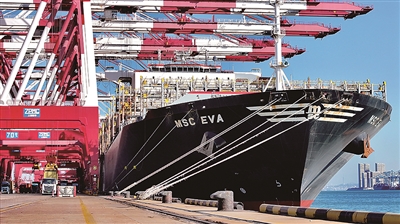
The bustling docks bear witness to the resilience of Qingdao's foreign trade. On the 8th, as the container ship "MSC EVA," carrying 10,612 TEUs, completed its loading and unloading operations at the Qianwan Port Area, the annual cargo throughput of Shandong Port Qingdao Port officially surpassed 700 million tons, reaching this milestone 15 days earlier than in 2024.
What does it mean to handle 700 million tons of cargo in just 342 days? If loaded onto train wagons with a capacity of 60 tons each, it would require over 11.66 million wagons, meaning one wagon is filled every three seconds on average.
Earlier, on November 26, Qingdao Port's container throughput also broke the 30 million TEU mark. This is equivalent to loading or unloading one container every second, highlighting its comprehensive strength as an international hub port.
Against the backdrop of a rapidly changing international environment and pressures on foreign trade, how has the port maintained steady growth? According to Qingdao Port officials, multiple factors have contributed to this record-breaking throughput.
The resilience of the port's throughput firstly stems from the profound optimization of its shipping route network and cargo structure. This year, Qingdao Port has adopted a dual-pronged approach, strengthening both sea and land routes. In the maritime direction, 20 new container shipping routes were added, expanding the total to nearly 240 routes covering over 700 ports in more than 180 countries and regions. Routes related to the Belt and Road Initiative and RCEP countries account for over 60% of the total. On land, 54 inland ports have been established, and 86 sea-rail intermodal train services have been launched. In the first 11 months, the sea-rail intermodal transport volume reached 2.625 million TEUs, an 11% year-on-year increase, maintaining its top position among China's coastal ports. Meanwhile, in addition to traditional bulk commodities, high-value-added goods such as the "new three" items (new energy vehicles, lithium-ion batteries, and solar products), high-end equipment, and precision instruments have become significant growth drivers.
Secondly, major port projects have created new capacity for the large-scale inflow and outflow of goods. This year, Qingdao Port initiated 15 major projects, adding 16 million tons of terminal handling capacity, 1.46 million square meters of yard space, and 132,000 cubic meters of liquefied hydrocarbon storage. In particular, the commissioning of the second 400,000-ton ore terminal has established a new development paradigm where its two massive terminals operate in powerful synergy. This has significantly enhanced its hardware capabilities and accelerated the rise of a hundred-billion-level port-side industrial cluster, reaffirming the industry motto that "tonnage determines status."
Supporting this highly efficient logistics operation is the development of a smart and green port. Building on the nation's first fully domestically-produced and independently-developed automated terminal, Qingdao Port is accelerating the iteration and upgrading of its smart port capabilities. It is promoting the commercialization of its AI application pilot base, advancing the automation of traditional terminals, and has repeatedly broken efficiency records for handling containers, pulp, iron ore, and grain. The "Yungangtong" online port service platform was launched, along with the world's first port service large model, Ark TaaS (Transportation as a Service). Furthermore, Qingdao Port has integrated green and low-carbon concepts throughout its entire development chain, introducing diesel-electric and hydrogen-electric tugboats, pioneering the world's first elevated rail container transport system, formulating a green and low-carbon transition plan, releasing a "carbon neutral" port evaluation standard, building China's first port-based hydrogen refueling station, and comprehensively upgrading its shore power facilities. (By Zhou Xiaofeng, Qingdao Daily/Guanhai News)
Editor: Yuan Ruichen


